
Intro/Background
• Dialectical Behaviour Therapy (DBT; Linehan, 1993) is a well-established treatment for individuals with borderline personality disorder (BPD)
• Less is known about the which may affect treatment attendance to DBT skills group has been found to have positive effects on treatment (Yin et al., 2022; Blackford & Love, 2011) although, data on skills group attendance is not often reported
Methods
• This study sought to examine the relationships between attendance at skills groups and treatment outcomes for DBT patients over the duration of their program.
• H1) Post-treatment, significant improvements in clinical symptomatology will be observed across measures
• H2) Higher frequency of attendance at skills group would be associated with greater improvements in clinical outcome measures
Participants
• (N = 214) Patients completing comprehensive DBT treatment in an outpatient clinic in Southern California.
• The sample was 65% cisgender women with a mean age of 27.65 years (SD = 11.06).
Measures
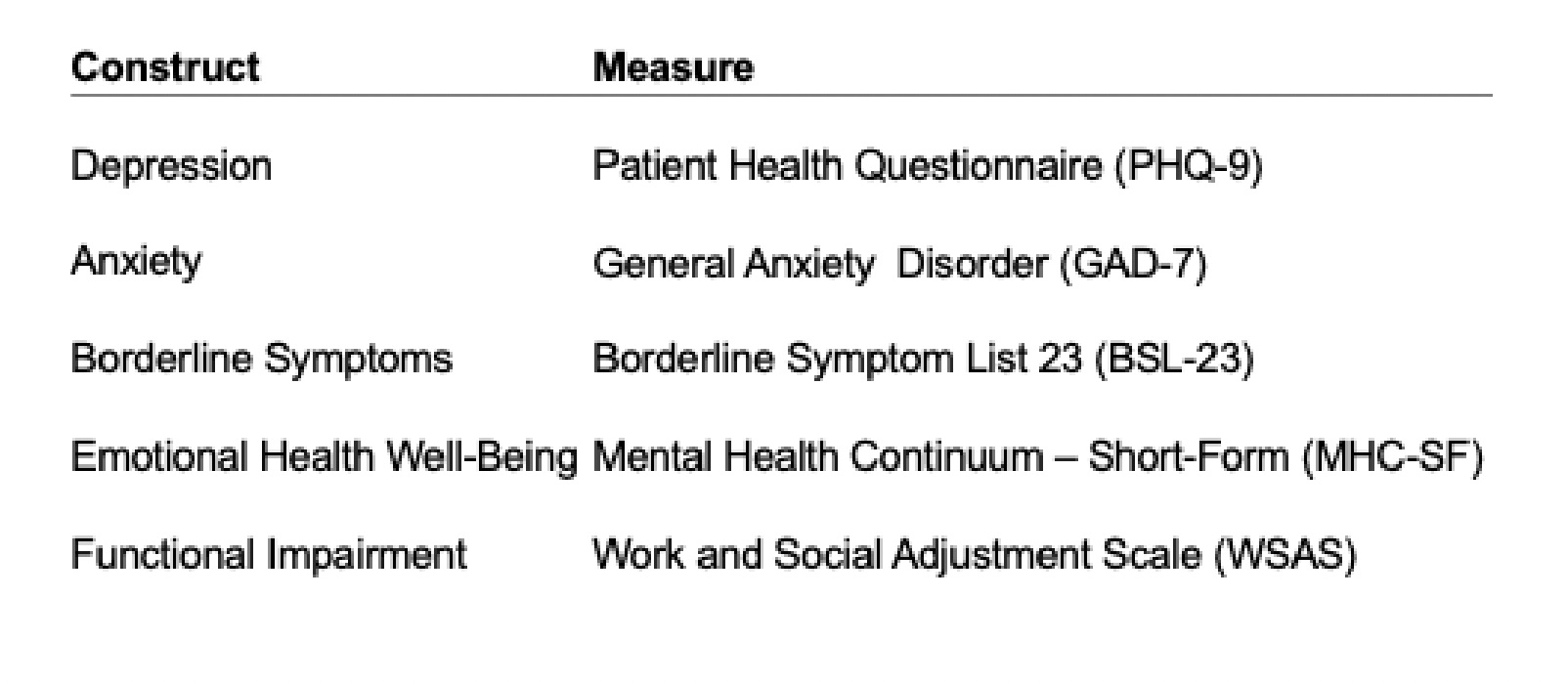
• BSL-23, PHQ-9, GAD-7, WSAS and MHC-SF-14, and were collected every two months.
Analysis
• Multi-level models were fit for each treatment outcome, and included predictors: time (in months), mean skills group attendance , and the interaction between time and attendance
Results
• H1: As predicted, significant improvements were found over the course of treatment for all measures.
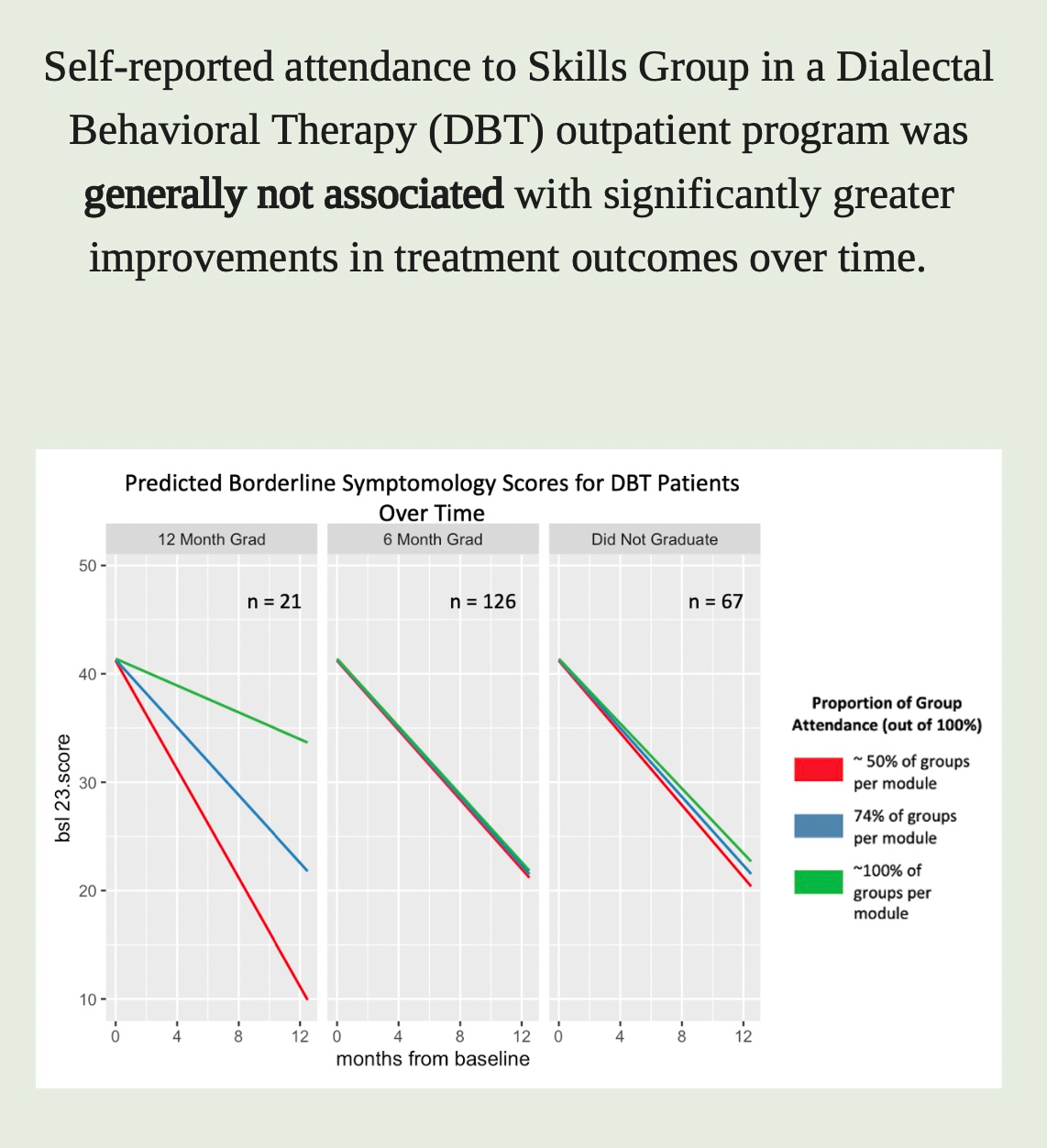
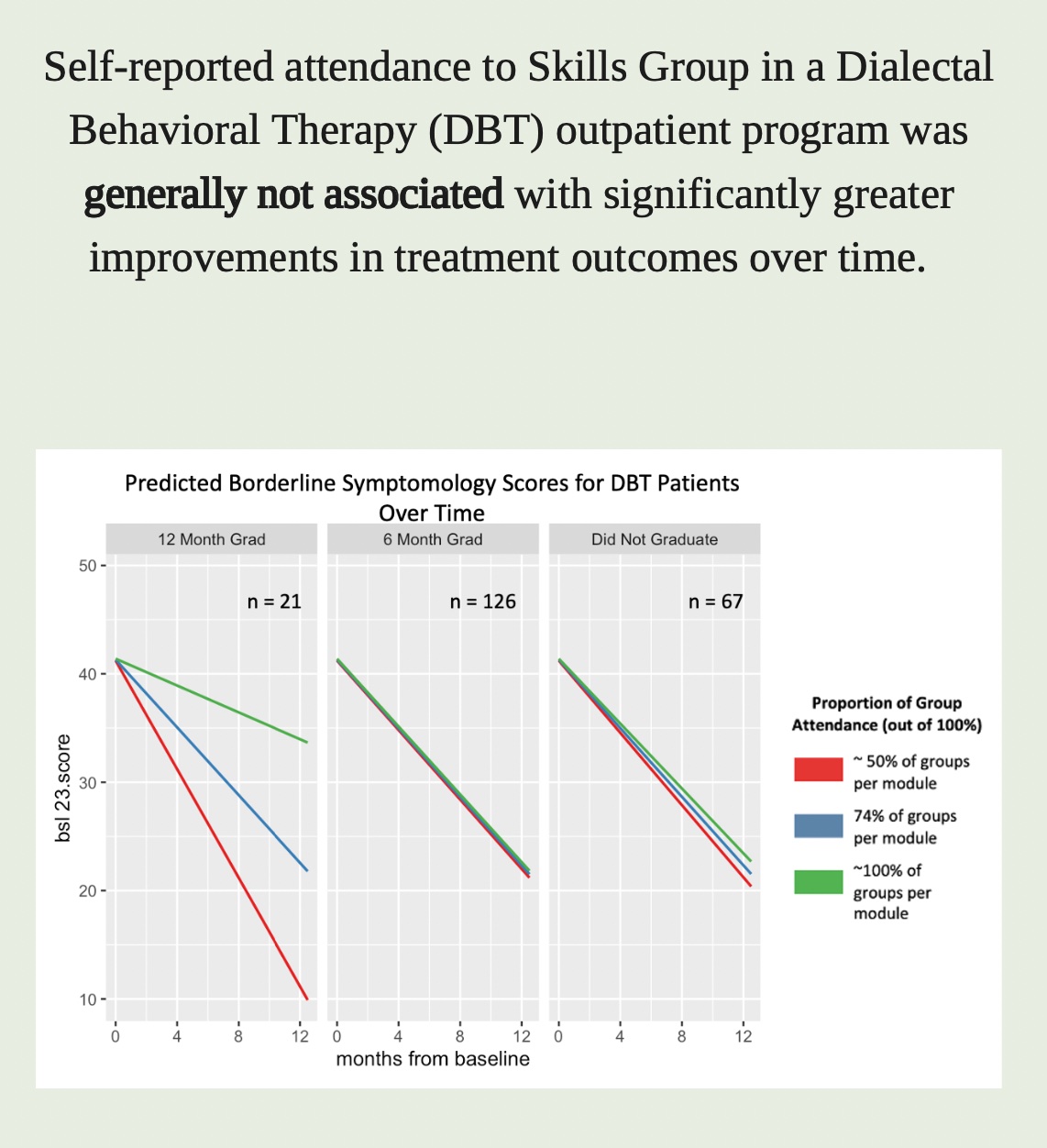
• H2: Contrary to our prediction, for almost all outcomes, no significant interactions were found between attendance at DBT skills group and change in symptoms over time.
• Uniquely, the BSL-23 displayed a significant interaction between months in treatment and average skills group attendance (b = .55, se = .14, p < .001) for 12-month graduates only.
• This suggests those within this subsample who attended a greater average number of group sessions reported less improvement per month than those who attended fewer sessions.
Discussion
• Our findings follow the expected trend of observed improvements over the course of treatment.
• Unexpectedly, the data suggests a weak relationship between DBT group attendance and improvement in treatment outcomes
• Even more counterintuitively, 12-month graduates who attended more DBT group sessions were predicted to report slower improvement in BPD symptoms
• However, this result should be interpreted with caution due to several limitations
• If legitimate, a possible explanation may be that a longer-term program may slow symptom recovery, in line with McMain et. al (2022)
Limitations & Future Research
• Selection effect: participants were excluded from the study if they did not report attendance, meaning a possible underrepresentation of program sample
• Small sub-sample size for the 12 month graduates
• Data on skills group attendance was self-reported retrospectively
• Future studies could longitudinally re-evaluate the relationship between skills attendance and treatment outcomes by tracking attendance throughout treatment rather than post-treatment.
Research conducted by: Dexter Chia, Psy.D., Caitlin Hibbs, B.Sc., Robert Montgomery, M.A., Alexandra King, Ph.D., & Lynn McFarr, Ph.D.
References
Blackford, J. U., & Love, R. (2011). Dialectical behavior therapy group skills training in a community mental health setting: a pilot study. International journal of group psychotherapy, 61(4), 645–657. https://doi.org/10.1521/ ijgp.2011.61.4.645
Linehan, M. M. (1993). Cognitive-behavioral treatment of borderline personality disorder. Guilford Press.
McMain, S. F., Chapman, A. L., Kuo, J. R., Dixon-Gordon, K. L., Guimond, T. H., Labrish, C., Isaranuwatchai, W., & Streiner, D. L. (2022). The Effectiveness of 6 versus 12 Months of Dialectical Behavior Therapy for Borderline Personality Disorder: A Noninferiority Randomized Clinical Trial.Psychotherapy and psychosomatics, 91(6), 382–397. https://doi.org/10.1159/000525102 Yin, Q., Selby, E. A., & Rizvi, S. L. (2022). Trajectories and Processes of Symptom Change Over Time in Dialectical Behavior Therapy for Borderline Personality Disorder. Behavior therapy, 53(3), 401–413. https://doi.org/10.1016/ j.beth.2021.10.002


