
Background
Dialectical Behavior Therapy (DBT) was adapted from Cognitive Behavioral Therapy (CBT) to better meet needs of patients with Borderline Personality Disorder (BPD) [1]
– treatment prioritizes modification of life-threatening behaviors
DBT patients experience signifIcantly greater reductions in self- directed violence, utilization of crisis resources than patients who receive other treatments [2]
However, DBT has not shown the same relative efcacy for reduction of patients’ suicidal ideation [2]
– speculated to result from DBT’s decreased emphasis upon cognitive symptoms in training and treatment planning
CBT treatments, however, signifcantly outperform other treatments in reducing patients’ suicidal ideation [3]
Only if suicidal cognition and behavior are targeted directly
Given these fndings, CBT-informed DBT treatment may be uniquely suited to treat suicide ideators entering treatment with concerns related to borderline symptoms and/or self-directed violent behaviors
– clinicians formally trained in CBT as well as DBT
– supervisors provide explicit direction for integration of cognitive interventions during treatment planning
Current Study
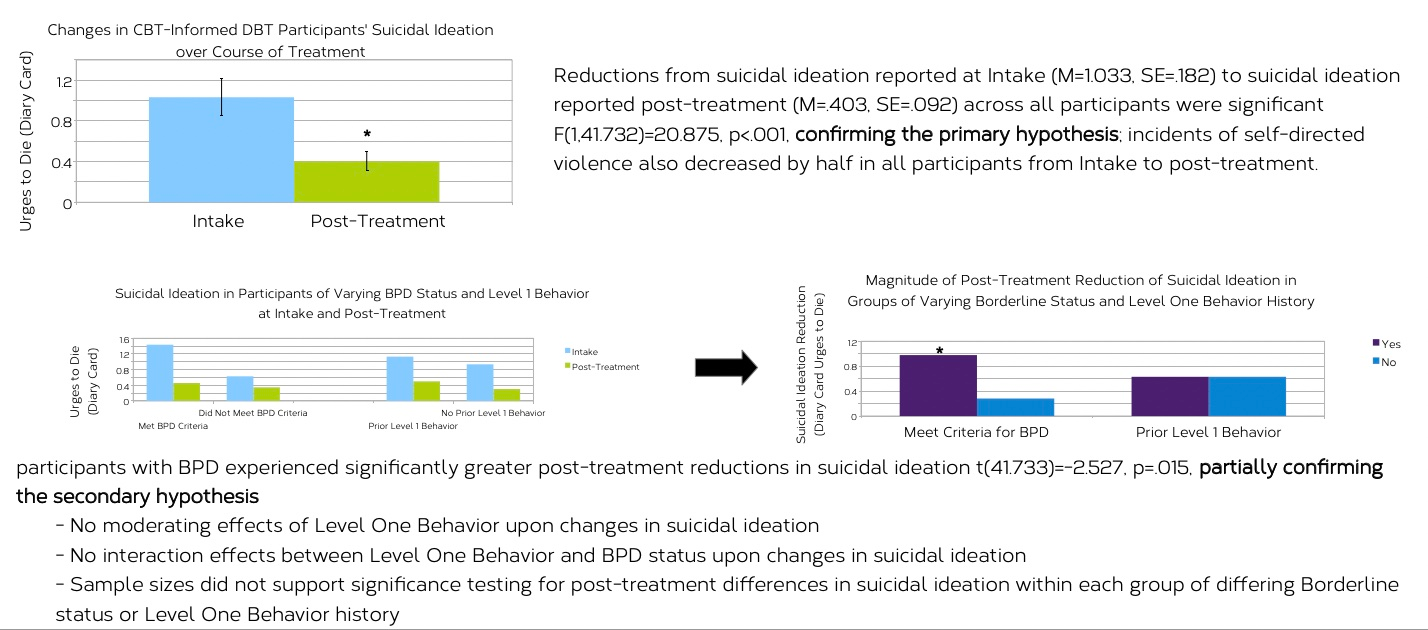
1) Determine if participants in CBT-informed DBT experience reductions in suicidal ideation
Hypothesis: participants in CBT-informed DBT will report signifcantly less suicidal ideation post-treatment than at Intake
2a) Determine if participants that meet criteria for BPD experience signifcantly diferent reductions in suicidal ideation than participants who do not meet criteria
2b) Determine if participants that report prior Level One Behavior (danger to self, others, others’ property) at Intake experience signifcantly diferent reductions in suicidal ideation than participants without prior Level One Behavior
Hypothesis: participants who meet criteria for BPD will experience signifcantly greater post-treatment reduction in suicidal ideation than participants who do not; participants reporting Level One Behavior at Intake will experience signifcantly greater post-treatment reduction in suicidal ideation than participants without prior Level One Behavior
Participants
42 adult participants in CBT-informed DBT treatment at a Southern California outpatient private practice and training center
– Mean Age of Participants: 27.64; 31 [73.81%] female participants, 21 [50%] White participants
– 22 participants [52.38%] met criteria for BPD
– 28 participants [66.67%] reported prior Level One Behavior
– 8 participants [19.05%] met criteria for BPD and reported prior Level One Behavior
Inclusion Criteria: All participants expressed suicidal ideation at Intake on either/both the PHQ-9 or OQ-45 and have completed at least one eight-week treatment module [4, 5]
Methods
As part of treatment, participants track their daily urges, feelings, and behaviors in weekly Diary Cards
– Urges to Die reported on a 6-point Likert Scale (0 = no urges at all, 5 = the most intense urges possible)
Controlling for time spent in treatment, researchers compared participants’ average reported Urges to Die in frst four and most recent four Diary Cards using a multilevel model with non-nested factors to:
1) evaluate post-treatment change in suicidal ideation across all participants
2) evaluate diferences in post-treatment change in suicidal ideation between groups of difering Borderline status, and between groups with difering history of Level One Behavior
Results

Discussion
● These fndings indicate that CBT-informed DBT can significantly reduce suicidal ideation in adult suicide ideators
– most efective for patients that meet criteria for BPD, but patients that do not meet criteria also improved
– equally efective for patients with prior Level One Behavior and without
● Findings support DeCou, Comtois, and Landes’ (2018) suggestion that increased emphasis on cognition in the training and/or treatment planning of DBT therapists will result in more efective treatment of suicidal ideation [2]
● May also provide evidence for CBT-informed DBT’s efcacy for reducing patients’ self- directed violence in an outpatient private practice setting
Directions for Future Research:
– identify specifc mediators of change to suicidal ideation in CBT-informed DBT (e.g. training components, therapist techniques)
– replicate study with larger sample to allow within-group signifcance testing for post-treatment changes in suicidal ideation, self-directed violence
– replicate study with adolescent population
References
1) Linehan, M.M. (1993). Skills training manual for treating borderline personality disorder. New York, NY: Guilford.
2) Decou, C. R., Comtois, K. A., & Landes, S. J. (2018). Dialectical behavior therapy is effective for the treatment of suicidal behavior: a meta-analysis. Behavior Therapy. doi:10.1016/j.beth.2018.03.009
3) Mewton, L., & Andrews, G. (2016). Cognitive behavioral therapy for suicidal behaviors: Improving patient outcomes. Psychology Research and Behavior Management, 21. doi:10.2147/prbm.s84589
4) Bauer, A. M., Chan, Y., Huang, H., Vannoy, S., & Unützer, J. (2012). Characteristics, management, and depression outcomes of primary care patients who endorse thoughts of death or suicide on the PHQ-9. Journal of General Internal Medicine, 28(3), 363-369. doi:10.1007/s11606-012-2194-2
5) Bryan, C. J. (2007). Empirically-Based outpatient treatment for a patient at risk for suicide: The case of “John”. Pragmatic Case Studies in Psychotherapy, 3(2). doi:10.14713/pcsp.v3i2.897
Research conducted by:
Max Stivers, M.A., Marget Thomas, Psy.D., Hollie Granato, Ph.D., Robert Montgomery, B.F.A., Kate Cohen, B.A., Sandra Chen, M.A., Lindsey Thornburg, B.A., and Lynn McFarr, Ph.D.


