
Introduction
- Nearly 50% of patients diagnosed with BPD have a comorbid substance use disorder (2,3)
- Studies show mixed conclusions linking emotion regulation (4) and distress tolerance (5) to reduced substance frequency.
- In a study on DBT for substance abuse disorders, the emotion regulation skill of “cope ahead” was related to
reduction in substance use urges (6)
Objectives
• Aim #1: Examine changes in substance use urges from pre- to post- treatment
• Aim #2: Explore associations of DBT skills with substance use urges.
Methods
AIM #1:
• Used a multilevel model to assess patients’ substance use urges (0-5) during the first and last four weeks of DBT treatment (6 months).
• Study used self-reported Weekly Diary Card data from 44 adult patients (7 patients were excluded due to missing data)
• N=193 diary cards
o First 4 weeks (88 diary cards)
o Last 4 weeks (105 diary cards)
Aim #2:
• Pearson’s Correlation was used to assess the strength of the relationship between urges (0-5) and DBT skills usage (average weekly)
• Study used self-reported Weekly Diary Card data from 44 adult patients
Demographics:
• 12 males, 32 females
• 21 White, 2 Black or African-American, 1 Asian, 15 declined
• Median age is 25
Discussion
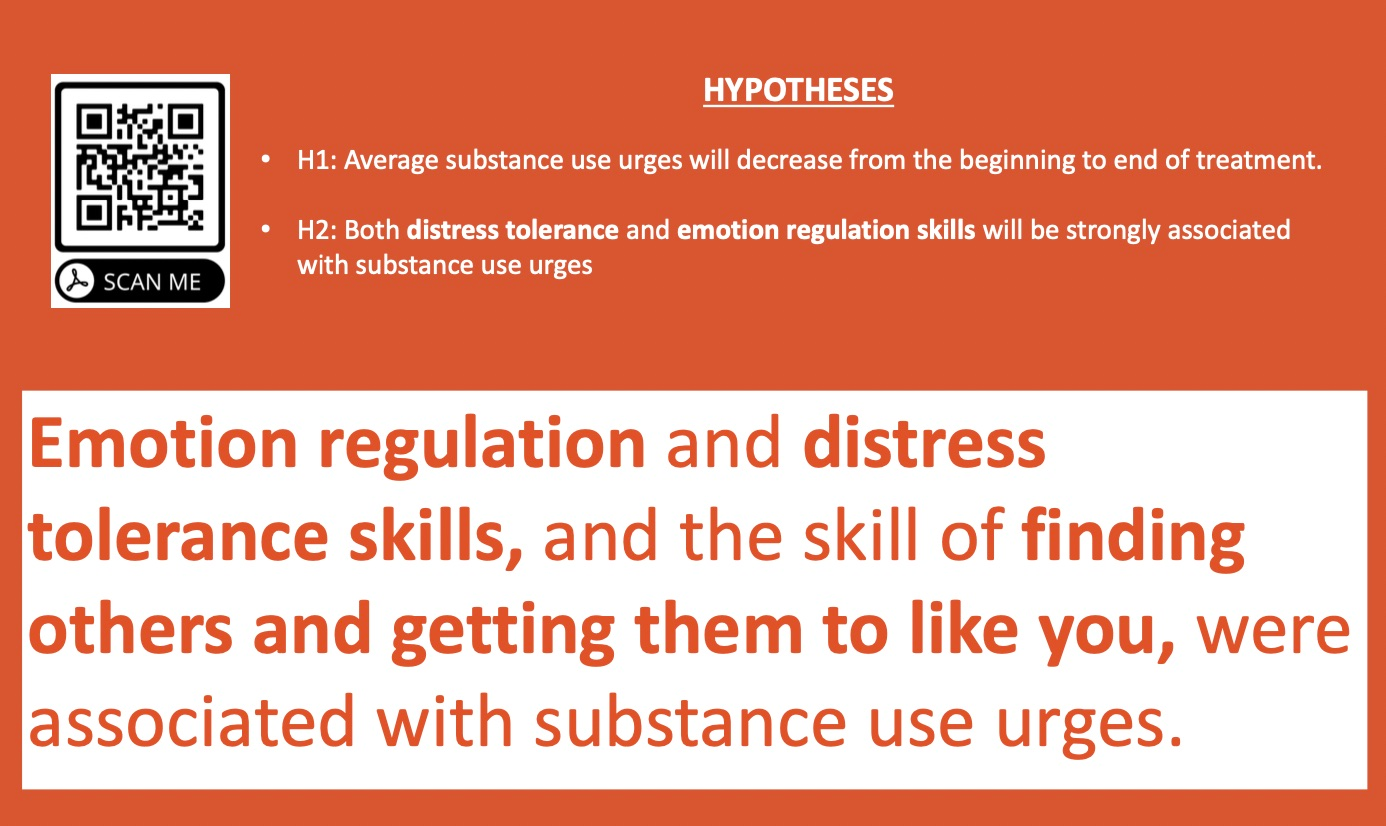
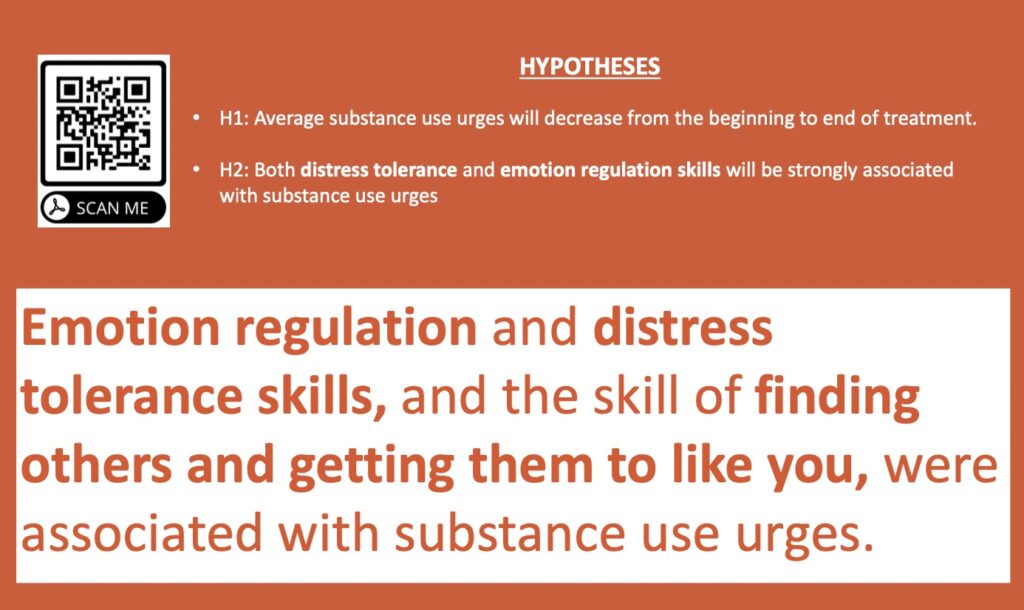
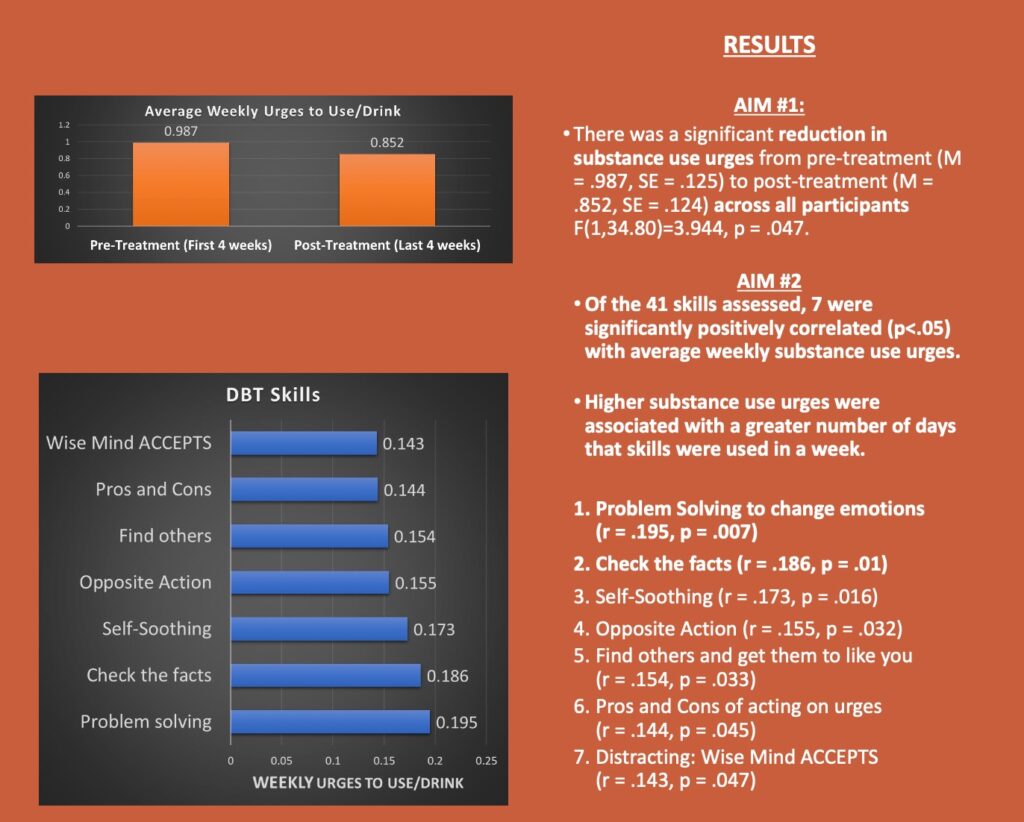
This study found that emotion regulation, and distress tolerance skills had the strongest link to substance use urges.
- It is unclear if patients chose these skills in response to substance use urges, or whether patients’ urges were responding to the use of skills.
- Suggests that when patients have high urges, they seem to use these seven skills more frequently that week.
Limitations & Future Directions
Limitations:
• Due to limited and incomplete Diary Card data, and lack of temporal data, the analysis lacks data about actual usage. We cannot make assumptions about why these skills had the strongest associations with urges.
Future Directions:
• Collecting data that includes the actual usage of substances (not only urges) and a design that can tell us more about the causal relationship between skills use and urges.
• Using more refined day-to-day urges and skills usage rather than weekly
Research conducted by: Sandra Chen, M.A., Erica Rozmid, Ph.D., Rob Montgomery, M.A., Adina Polack, B.A. Lindsey Thornburg, B.A., Marget Thomas, Psy.D., and Lynn McFarr, Ph.D.
References
1.Linehan, M. M., Schmidt, H., 3rd, Dimeff, L. A., Craft, J. C., Kanter, J., & Comtois, K. A. (1999). Dialectical behavior therapy for patients with borderline personality disorder and drug-dependence. The American journal on addictions, 8(4), 279– 292. https://onlinelibrary.wiley.com/doi/10.1080/105504999305686
2.Fox, H. C., Hong, K. A., & Sinha, R. (2008). Difficulties in emotion regulation and impulse control in recently abstinent alcoholics compared with social drinkers. Addictive behaviors, 33(2), 388–394. https://doi.org/10.1016/j.addbeh.2007.10.002
3.Trull, T. J., Freeman, L. K., Vebares, T. J., Choate, A. M., Helle, A. C., & Wycoff, A. M. (2018). Borderline personality disorder and substance use disorders: an updated review. Borderline personality disorder and emotion dysregulation, 5, 15. https://doi.org/10.1186/s40479-018-0093-9 (Cavicchioli et al, 2019)
4.Cavicchioli, M., Movalli, M., Vassena, G., Ramella, P., Prudenziati, F., & Maffei, C. (2019). The therapeutic role of emotion regulation and coping strategies during a stand-alone DBT Skills training program for alcohol use disorder and concurrent substance use disorders. Addictive Behaviors. https://doi.org/10.1016/J.ADDBEH.2019.106035
5.Reese, E. D., Conway, C. C., Anand, D., Bauer, D. J., & Daughters, S. B. (2019). Distress tolerance trajectories following substance use treatment. Journal of consulting and clinical psychology, 87(7), 645–656. https://doi.org/10.1037/ccp0000403
6.Dimeff, L. A., & Linehan, M. M. (2008). Dialectical behavior therapy for substance abusers. Addiction science & clinical practice, 4(2), 39–47. https://doi.org/10.1151/ascp084239


