
INTRO:
- For caregivers of individuals who meet criteria for borderline personality disorder, adolescents’ impairments in interpersonal functioning and emotion regulation are key features of the disorder that lead to increased stress and ineffective caregiving (Bailey & Grenyer, 2013).
- It is suggested that maladaptive parenting responses may result from psychological inflexibility, with greater psychological flexibility resulting in more adaptive parenting responses (Wallace, Woodford, & Connelly, 2016).
- Parents, of children with behavioral problems, that endorse high levels of mindfulness may experience less parental stress than those with lower levels of mindfulness (Chan & Lam, 2017).
- This study aims to investigate the relationship between psychological flexibility, mindfulness, and parental stress at the time of intake for caregivers who have loved one’s enrolled in a comprehensive Dialectical Behavior Therapy (DBT) program.
METHODS:
PARTICIPANTS
• N=32; individuals were enrolled in a parent skills training program designed to aid caregivers in increasing adaptive parenting responses to their children who were enrolled in a comprehensive DBT program.
• All participants were parents or caregivers of someone receiving high fidelity DBT to address emotion dysregulation.
• Self-report measures were used for data collection.
MEASURES
• Five Facet Mindfulness Questionnaire (FFMQ-15).
• Parental Stress Scale (PSS-18).
• Parental Acceptance Scale (6-PAQ).
HYPOTHESES
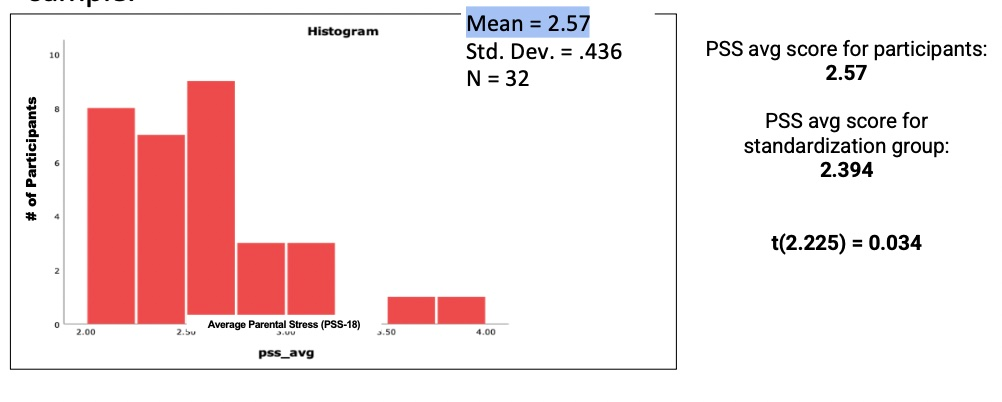
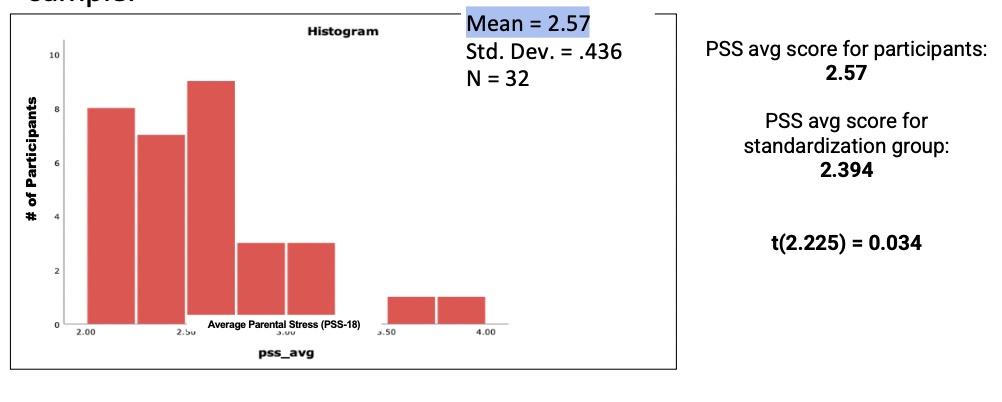
• Hypothesis 1: Parents/caregivers enter the program with above average levels of stress.
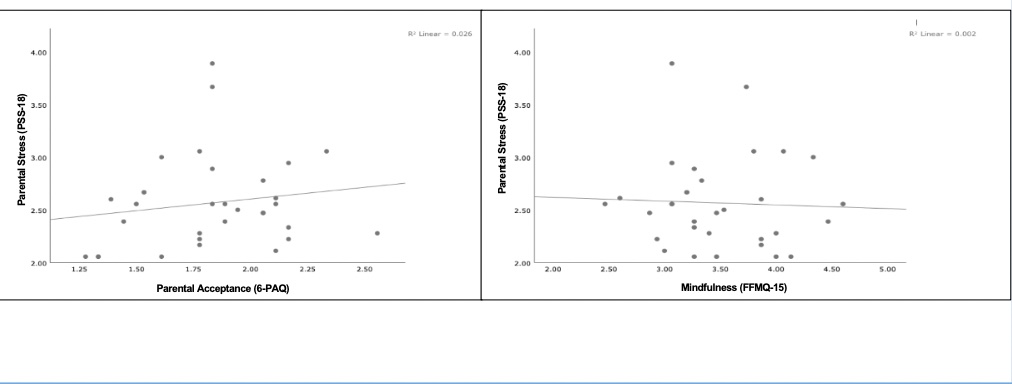
• Hypothesis 2: High parental/caregiver stress will be negatively correlated with low levels of mindfulness and low levels of psychological flexibility.
OUTCOMES:
HYPOTHESIS 1
• Supported: Parents/caregivers endorsed statistically higher levels of parental stress at intake when compared to the standardization sample.
HYPOTHESIS 2
• Not supported:No significant correlations between high parental stress, psychological flexibility, and mindfulness.
RESULTS:
• As predicted, caregivers participating in the DBT Parent Skills Program endorsed high levels of parental stress at intake as reported by the PSS-18.
• There were no statistically significant correlations between participants’ high stress levels and their levels of psychological flexibility nor their levels of mindfulness; however, the data revealed the following trends:
DATA TRENDS
• The correlation coefficients were trending in the directions hypothesized. (See Table 1)
• High levels of stress trended toward a negative correlation with levels of mindfulness.
• Levels of psychological flexibility trended toward a negative correlation with high stress.
• Levels of mindfulness trended toward a negative correlation with psychological flexibility.
DISCUSSION:
• Though participants reported high stress levels at intake, as hypothesized, few other correlations could be definitively drawn, which may be due to the low statistical power resulting from the small sample size.
• There was some non-normality presented in the variables. Parental stress, in particular, had a strong positive skewness and high kurtosis. This suggests that in a larger sample researchers might expect Hypothesis 2 to be supported.
• The current data highlight the importance of providing caregivers appropriate stress management tools, strategies, and psychoeducation in order to promote effective caregiving.
• This exploratory study intended to address the lack of attention given to those caring for individuals with severe emotion dysregulation. The researchers hope that the preliminary data presented here, encourages future research in the area, with particular emphasis on the impact of parental stress on levels of mindfulness and psychological flexibility.
REFERENCES:
• Beeckman,M.,Simons,L.E.,Hughes,S.,Loeys,T.,&Goubert,L.(2019). Investigating how parental instructions and protective responses mediate the relationship between parental psychological flexibility and pain-related behavior in adolescents with chronic pain: a daily diary study. Frontiers in Psychology, 10, 2350.
• Chan,T.O.,&Lam,S.-F.(2017). Media to ror moderator. The role of mindfulness in the association between child behavior problems and parental stress. Research in Developmental Disabilities, 70, 1–10. https://doi.org/10.1016/j.ridd.2017.08.007
• Chong,Y.Y.,Mak,Y.W.,&Loke,A.Y.(2017). Psychological flexibility in parents of children with asthma: Analysis using a structural equation model. Journal of Child and Family Studies, 26(9), 2610–2622. https://doi.org/10.1007/s10826-017-0757-x
• Fung,K.,Lake,J.,Steel,L.,Bryce,K.,&Lunsky,Y.(2018). ACT processes in group intervention for mothers of children with autism spectrum disorder. Journal of Autism and Developmental Disorders, 48(8), 2740–2747. https://doi.org/10.1007/s10803-018-3525-x
• Wallace,D.P.,Woodford,B.,&Connelly,M.(2016). Promoting psychological flexibility in parents of adolescents with chronic pain: Pilot study of an 8-week group intervention. Clinical Practice in Pediatric Psychology, 4(4), 405–416. https://doi.org/10.1037/cpp0000160
Research conducted by: Ashley Conner, M.A., Jaz Robbins, M.A. Adina Polack, Zach Rush, Rob Montgomery, Erica Rozmid, Ph.D., Marget Thomas, Ph.D., Lynn McFarr, Ph.D.


