
Background
•According to the Emotional Cascade Model (ECM), rumination is part of a positive feedback loop which amplifies negative affect, leading to emotional and behavioral dysregulation (Selby et al. 2014)
•DBT is an effective treatment for reducing Borderline symptoms (Linehan 1993)
•The brooding aspect of rumination has been linked to longer lasting and more severe depression (Treynor 2003, Whitmer 2011).
•Brooding has been found to mediate the relationship between distress tolerance and depressive symptoms (Magidson 2013), and mindfulness and depressive symptoms (Shahar 2010).
•No other study to our knowledge has examined any aspect of rumination as a moderator for outcomes of DBT treatment.
Current Study
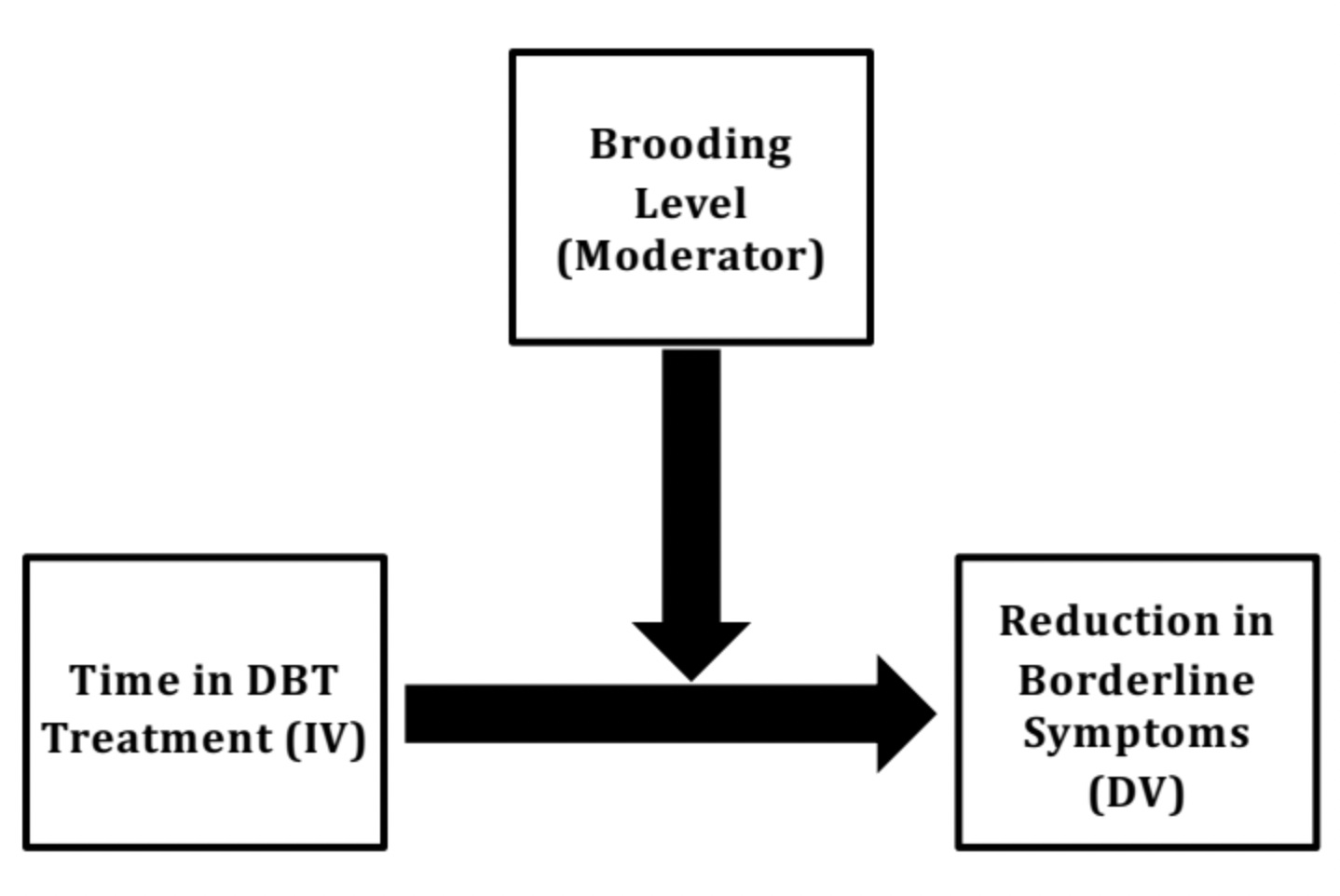
1) Test the prediction that brooding would act as a moderator between time in DBT treatment and changes in BSL scores.
We hypothesized that brooding would moderate the relationship between DBT treatment and reductions in Borderline symptoms, with higher levels of brooding resulting in smaller reductions in BSL scores over time.
Method
Participants
44 participants were drawn from a population of adult DBT patients at an outpatient private practice and training institute in Southern California. The average age of participants was 30 years old, with 68% female. 50% declined to state ethnicity and of the remainder 34% identified as White, 2% Black, 2% Asian, 2% Latino/a, and 9% as ”Other”.
Measures
Borderline Symptom List 23 (BSL-23): A self-report measures used to identify and quantify symptom severity related to Borderline Personality Disorder.
Ruminative Response Scale (RRS): A self-administered measure of rumination consisting of 22 items with two dimensions: brooding and reflection.
Procedure
Clients completed intake measures prior to DBT treatment including BSL, and RRS. Clients completed the same measures at a second time point, after a minimum 2 months, maximum 12 months treatment, with an average time between measures of 5.2 months.
Data Analysis
The PROCESS macro for SPSS (Hayes 2012) was used to examine brooding score (IV) as a moderator between the time in treatment (IV) and change in BSL score from T1 to T2 (DV) using a bootstrapping moderation analysis.
The moderation groups of “Low Brooding” “Average Brooding” and “High Brooding” were based on the standard deviation of the brooding scores in the sample. (Low < -1SD; Average = between -1SD and +1SD; High >+1SD)
Missing data (>0.26% of total items) was imputed using the average score for the measure from which the item score was missing.
Results
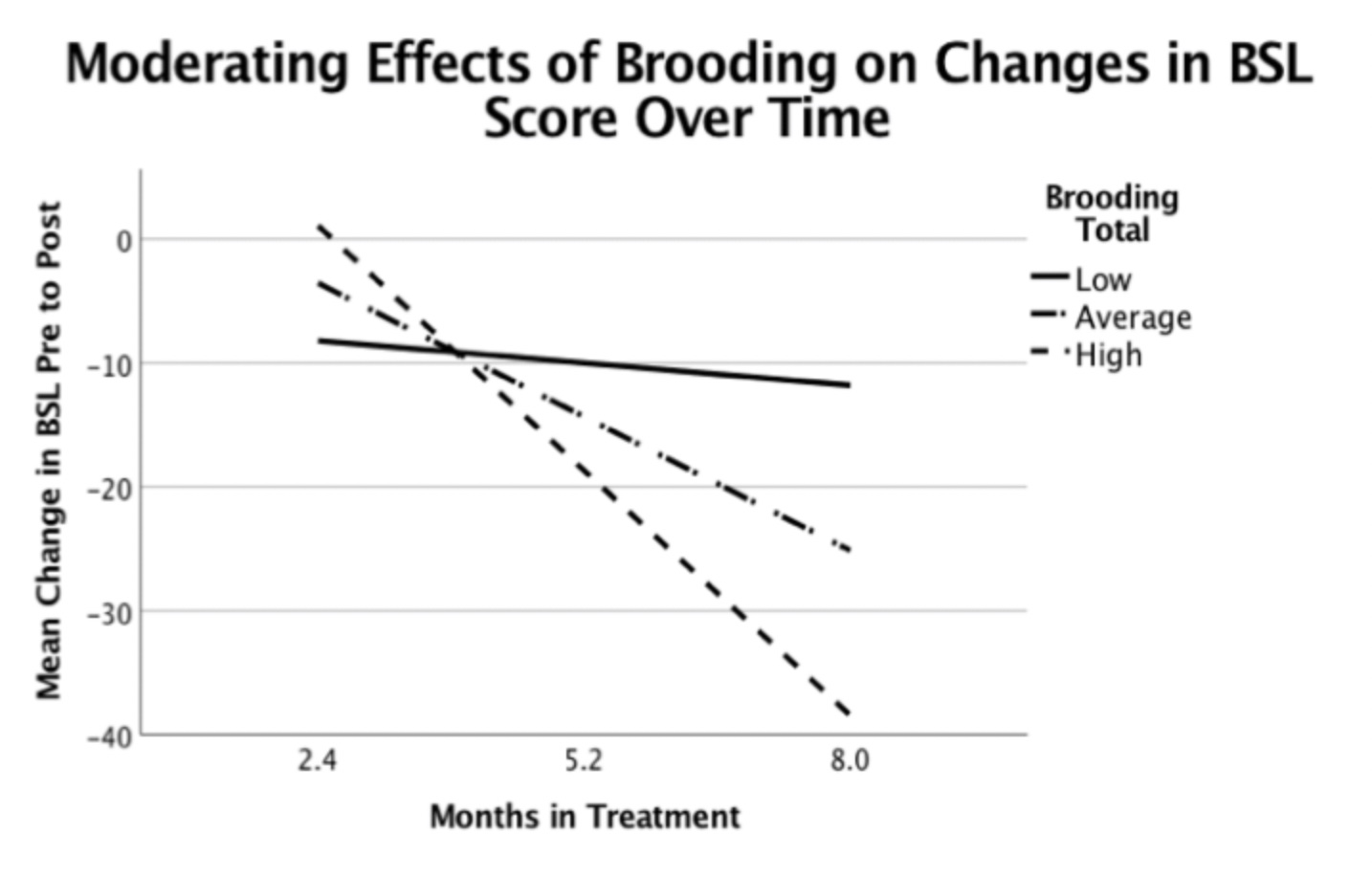
• Results show that the overall model was significant, R2 = .30, F(3,40) = 7.322, p < .001,, as was the interaction between brooding and time in treatment b = -.94, t(40) = -3.34, p = .002. Achieved power = ~.839
• Brooding was a significant moderator of the relationships between time in treatment and change in BSL score.
• The unstandardized simple slope for low brooders was b = -.64; average brooders b =-3.85; high brooders b = -7.07.
Discussion
- This naturalistic study in a real-world clinical setting provides support for the Emotional Cascade Model of BPD, the effectiveness of DBT, and the importance of brooding rumination in moderating treatment outcomes.
- Brooding does appear to moderate the relationship between time in treatment and reduction in Borderline symptoms; the greater the brooding at the outset of treatment, the larger the reduction in BSL scores
- Limitations include the quasi-experimental design, which did not allow for random assignment or comparison to a control group
- Knowledge of this potential moderating effect may be useful for DBT clinicians and researchers. Clinicians might encourage high brooding DBT patients with the results suggesting they are likely to improve dramatically if they remain in treatment.
- DBT may in fact be especially well-suited for patients with BPD who exhibit high brooding rumination.Research conducted by: Robert M. Montgomery, B.F.A., Allen Liao, Ph.D., Keren Shemesh, M.A., Amber Smith, M.A., Lisa Houghton, M.A., Max Stivers, B.A., Carol Lazo, M.B.A., Hollie Granato, Ph.D., Miriam Wollesen, Psy.D., & Lynn McFarr, Ph.D.
Selected References
Desrosiers, A., Vine, V., Klemanski, D. H., & Nolen-Hoeksema, S. (2013). Mindfulness and Emotion Regulation in Depression and Anxiety: Common and Distinct Mechanisms of Action. Depression and Anxiety, 30(7), 654–661. http://doi.org/10.1002/da.22124
Hayes, A. F. (2012). PROCESS: A versatile computational tool for observed variable mediation, moderation, and conditional process modeling. Retrieved from http://www.afhayes.com/public/process2012.pdf
Linehan MM. Cognitive-Behavioral Treatment for Borderline Personality Disorder. New York: Guilford Press; 1993 Magidson, J. F., Listhaus, A. R., Seitz-Brown, C. J., Anderson, K. E., Lindberg, B., Wilson, A., & Daughters, S. B. (2013).
Rumination Mediates the Relationship Between Distress Tolerance and Depressive Symptoms Among Substance Users. Cognitive Therapy and Research, 37(3), 456–465. http://doi.org/10.1007/s10608-012-9488-x
Selby, E. A., & Joiner, T. E. (2009). Cascades of Emotion: The Emergence of Borderline Personality Disorder from Emotional and Behavioral Dysregulation. Review of General Psychology : Journal of Division 1, of the American Psychological Association, 13(3), 219. http://doi.org/10.1037/a0015687
Selby, E. A., Kranzler, A., Panza, E., and Fehling, K. B. (2014). Bidirectional-compounding effects of rumination and negative emotion in predicting impulsive behavior: implications for emotional cascades. J.Personal. doi: 10.1111/jopy.12147
Shahar, B., Britton, W.B., Sbarra, D.A., Figueredo, A.J., and Bootzin, R.R. (2010). Mechanisms of Change in Mindfulness-Based Cognitive Therapy for Depression: Preliminary Evidence from a Randomized Controlled Trial. International Journal of Cognitive Therapy: Vol. 3, Special Section: Stress Generation, pp. 402-418. https://doi.org/10.1521/ijct.2010.3.4.402
Treynor, W., Gonzalez, R., & Nolen-Hoeksema, S. (2003). Rumination reconsidered: A psychometric analysis. Cognitive Therapy and Research, 27, 247–259. doi:10.1023/A:1023910315561
Whitmer, A., & Gotlib, I. H. (2011). Brooding and reflection reconsidered: A factor analytic examination of
rumination in currently depressed, previously depressed, and never depressed individuals. Cognitive Therapy and Research, 35, 99–107. doi:10.1007/s10608-011-9361-3


