
Background
● Studies have suggested a positive relationship between mindfulness and spirituality 4
● Positive correlations were found between spiritual beliefs and mindfulness (RICH scale) in psychiatric patients 5
● No known studies have looked at religiosity in DBT patients
Current Study
● Question: Does a patient’s intrinsic religiosity predict their mindfulness at intake?
● Hypothesis: [1] Higher levels of intrinsic religiosity will be positively associated with higher levels of mindfulness at intake.
Participants
● N=127 Adult DBT patients at an outpatient private practice and training institute in Southern California
● All participants had a DSM-5 diagnosis and completed at least 1 module of DBT
● Ethnicity: 45.8% White, 40.5% Declined to State
● Gender: 43.5% Declined to State, 40.5% Female, 13.7% Male, 1.6% Non-binary/third-gender, .8% Transgender
● Religious Affiliations by self-report: Agnostic, Atheist, Buddhist, Catholic, Christian, Jewish, Orthodox Jewish, Spiritual, None
Results
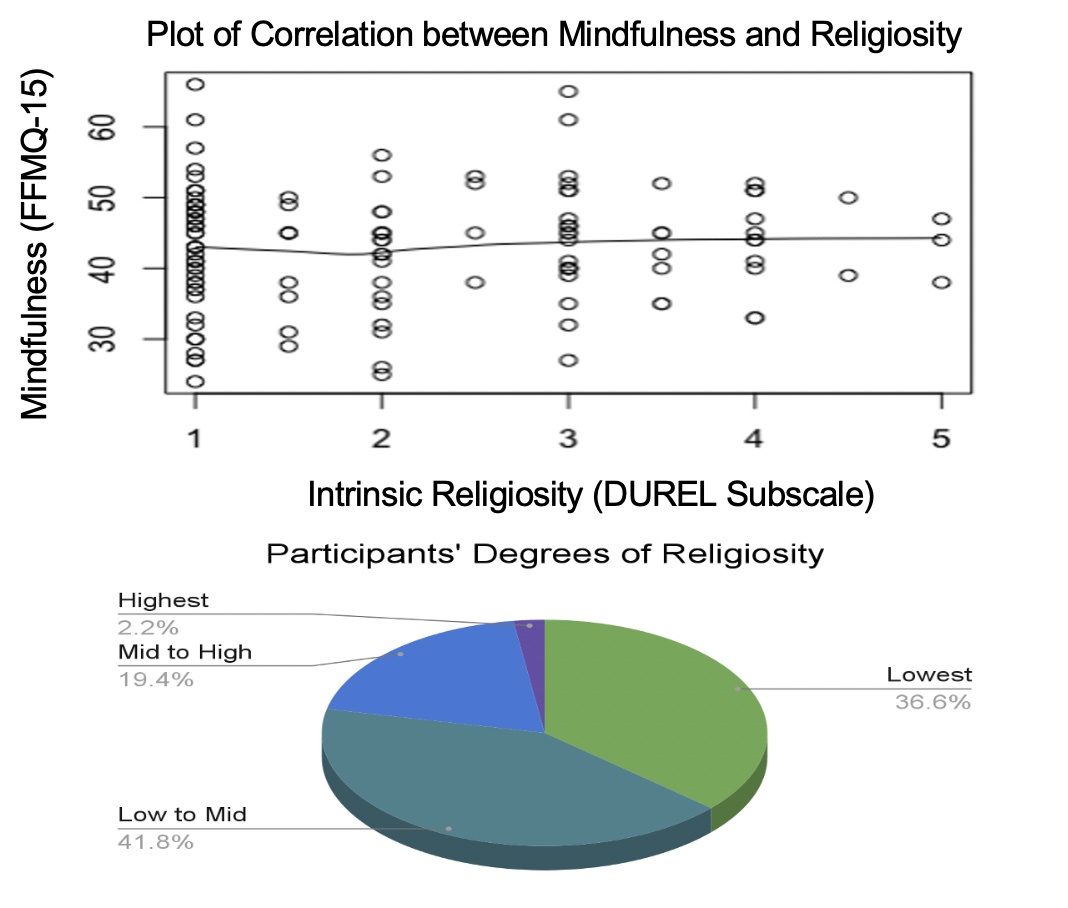
The correlation between the religiosity average and the FFMQ-15 total score was r = 0.075, n = 127
The regression model predicting mindfulness from religiosity was not significant: F(1,125) = .716, p = .399; Hypothesis was not supported
Measures
● Five Facet Mindfulness Questionnaire (FFMQ-15)2 taken at intake (M=43.13)
● Intrinsic Religiosity Subscale from Duke University Religion Index (DUREL)1 assessed after first module (M=2.18)
○ My religious beliefs [and/or spiritual values] are what really lie behind my whole approach to life.
○ I try hard to carry my religion [and/or spiritual values] over into all other dealings in life.
Discussion
● Mindfulness assessed and incorporated into DBT is non-religious
● FFMQ-15 assesses different facets than other mindfulness scales
● Religiosity data skewed towards lower levels
● Lack of diversity in participants’ religiosity, affiliation, gender, ethnicity, SES, etc.
Further Directions
● Assessing Outcome data
Could higher levels of intrinsic religiosity predict more positive changes in mindfulness or outcomes?
High self-rated importance of religion predicted improvement in symptoms after CBT 3
Research conducted by: Caroline Kutschbach, B.A., Robert Montgomery, M.A., Andrew Rogers, M.A., Marget Thomas, Psy.D., and Lynn McFarr, Ph.D.
