
INTRODUCTION:
• Anxiety disorders are highly prevalent among people with symptoms of borderline personality disorder (BPD), with comorbidity rates ranging from 75% to 90%1.
• Anxiety has been found to lessen the chance of achieving remission from BPD and increase the risk of suicide and self-harm among people with BPD2.
• Although recent studies have shown promising results using DBT among comorbid PTSD and BPD patients3,4, additional research should address comorbid anxiety symptoms other than PTSD.
CURRENT STUDY:
• This study aims to clarify the relationship between borderline symptom severity and changes in anxiety symptom severity among comorbid BPD/anxiety patients.
• Outcomes of interest:
• BSL-23 (Bohus et al., 2009)
• GAD-7 (Spitzer et al., 2006).
Method:
• Participants (N=42) who had completed measures at two time points (avg. time in treatment = 7 months) and did not meet criteria for PTSD were selected from a population of adult DBT patients in an outpatient multi-sited private practice and training facility in Southern California.
Hypotheses:
• H1: There will be a significant decrease in anxiety symptoms from pre- to post- treatment for non-PTSD DBT patients.
• H2: Borderline symptom severity at intake will moderate the effectiveness of DBT in reducing anxiety scores in a non-PTSD sample, such that those with higher initial BPD
• H3: The presence of a BPD diagnosis will be associated with greater reductions in anxiety symptoms over the course of treatment.
Results:
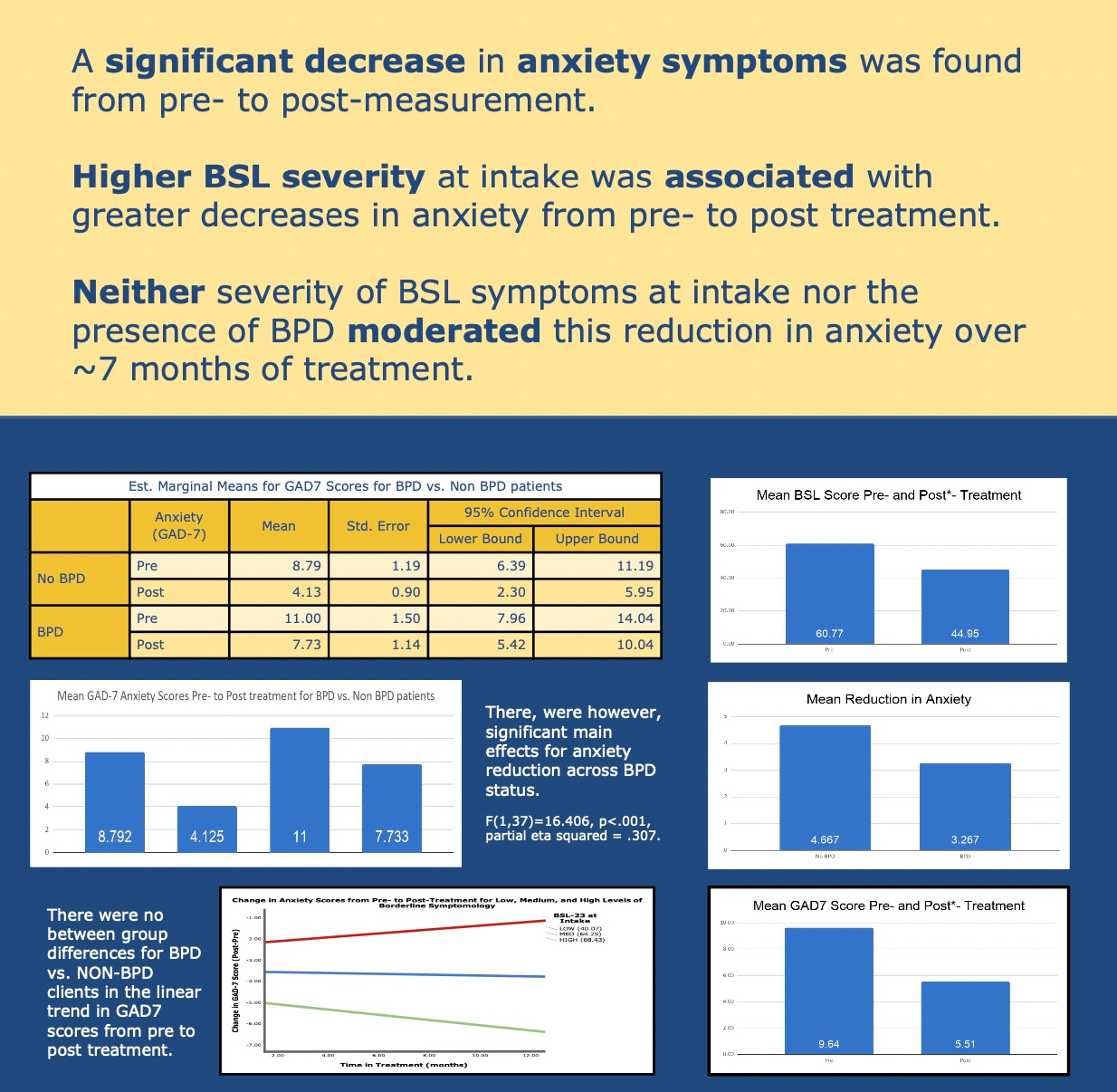
• H1: Supported.
There was a significant drop in anxiety pre to post for non-ptsd DBT patients. t(38)=4.360, p<.001.
• H2: Not Supported.
The severity of BSL scores did not significantly moderate the effect of DBT on anxiety.
The interaction effect was NOT significant: F Change(1,35)= 1.142, p = .293
• H3: Not Supported.
There was no interaction of BPD status with change in anxiety over the course of treatment.
Discussion:
• Findings suggests that DBT works approximately equally well in treating anxiety across different severities of borderline symptoms.
• Findings suggest that BPD and borderline symptom severity do not interfere with the efficacy of DBT in treating comorbid anxiety symptoms.
• This study is limited by a quasi-experimental design and small sample size.
• The present study adds to existing literature on the relationship between borderline symptomatology and anxiety and may offer inspiration for clinicians working with patients presenting with multiple comorbidities.
References:
Research conducted by: Sandra Chen, M.A. , Robert Montgomery, B.F.A., Marget Thomas, Psy.D., Amanda Loerinc, Ph.D., Max Stivers, M.A., Kate Cohen, B.A., and Lynn McFarr, Ph. D


