
Introduction
● Predictors of dialectical behavior therapy (DBT) response have been previously identified, such as baseline symptom severity and homework completion (Yin et al., 2022)
● Most of this literature has identified salient variables that predict treatment response in a controlled research setting
● Less work has aimed to predict treatment response to DBT within an outpatient community setting
● As a result, little is known about the predictors of DBT treatment response in real-world settings
● This research aims to use a data-driven machine learning approach to understand the predictors of DBT treatment response in an outpatient community setting
Methods
● Patients (N = 143; 64% female, 34% male, 2% non-binary or trans-identified, Mage = 31.42 years SDage = 10.70 years) enrolled in an outpatient DBT program in California
● Patient intake scores were assessed using a least absolute shrinkage and selection operator (LASSO) regression model
● The model was trained using ten-fold cross-validation and an alpha value of 1
● Predictor variables comprised relevant demographic and baseline variables (i.e., other psychiatric and psychosocial experiences) that have been implicated in prior work
● Dichotomized treatment response to DBT was calculated based on reliable clinical change (Jacobson & Truax, 1991), which was derived using intake and last assessed BSL-23 scores
● Model performance statistics include Accuracy and Area Under the Receiver Operating Curve (AUROC)
Results
Approximately 56.64% of individuals in the sample were classified as a treatment responder. There were no significant differences in the proportion of treatment responders across binary gender (X2(1) = 1.88, p = .18) and age (t(135) = .11, p = .91). Individuals who were categorized as treatment responders were significantly more likely to have graduated from DBT (X2(2) = 7.52, p = .02).
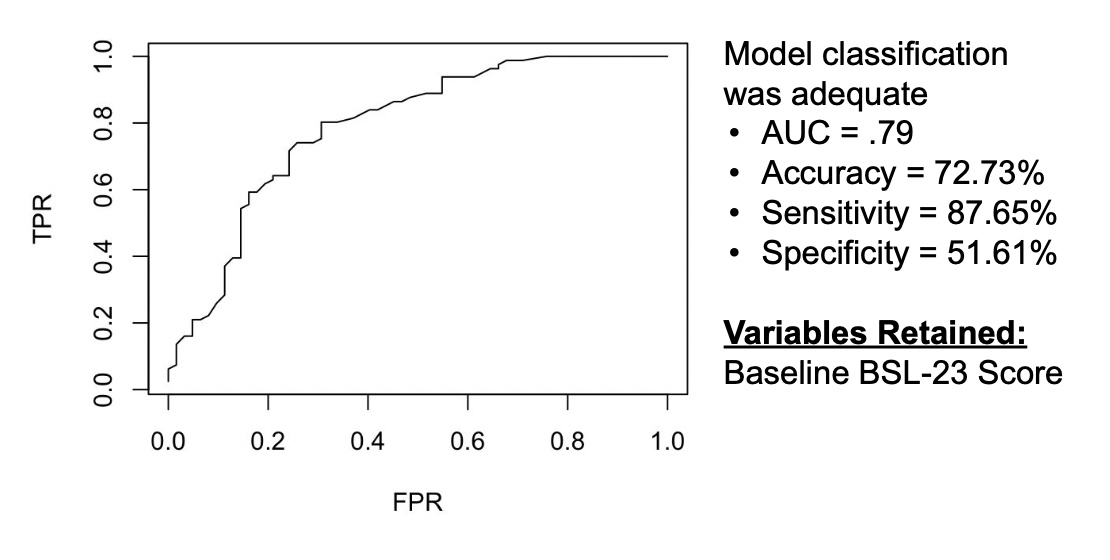
Figure 1.
AUROC of LASSO Model Predicting DBT Treatment Response With BSL-23 Scores
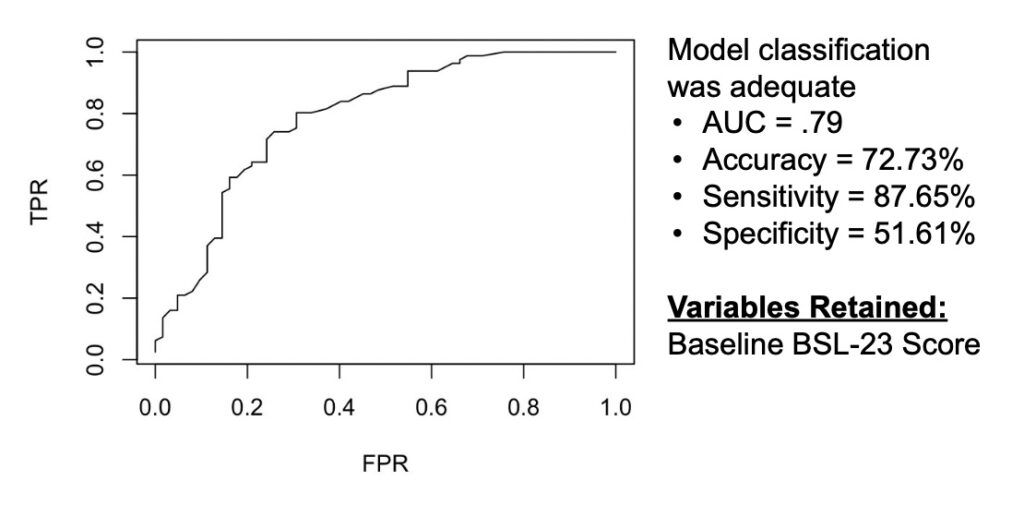
Figure 2.
AUROC of LASSO Model Predicting DBT Treatment Response Without BSL-23 Scores

Discussion
● Slightly over half of the sample (56.64%) was classified as a treatment responder based on their BSL-23 scores
● Individuals who graduated from DBT were significantly more likely to be classified as a treatment responder (p = .02)
● There were no significant differences in treatment response by binary gender or age
● Higher BSL-23 scores at baseline may be associated with a greater likelihood of responding to DBT
● When BSL-23 scores were removed, model performance declined slightly, and no variables were retained in the model
Future Directions
● More work is needed to understand the variables that predict treatment response in DBT in real-world settings, including treatment response as understood through change across different variables (e.g., emotion regulation, psychosocial functioning)
● Prior work has demonstrated difficulties in predicting treatment response in therapies for borderline personality disorder (Barnicot et al., 2012; Herzog et al., 2020)
● It is likely that a greater sample size and an increased number of features may be needed to understand generalizable predictors of DBT treatment response in real-world settings
● Other machine learning models may more appropriately capture any non-linear relationships between intake scores and DBT treatment response
Research conducted by: Katherine E. Wislocki, M.A.1,2, Rosa Hernandez-Ramos, B.A.1, Aleeza West, B.A. 2, Robert Montgomery, M.A.2, Alexandra King, Ph.D. 2, & Lynn McFarr, Ph.D. 2
1 University of California, Irvine
2 CBT California, Los Angeles, CA
Correspondence to:
Katherine Wislocki (kwislock@uci.edu)


