

Introduction
• Dialectical Behavior Therapy (DBT) is the primary treatment provided for complex psychological disorders. [1]
• However, there is a lack of evidence relating to the efficacy of DBT when used with individuals belonging to diverse groups.
• Harned and colleagues [2] suggest that existing randomized controlled trials of DBT research may adequately represent ethnoracial minority groups, but noted that improvements were needed in sample reporting and data analytic practices for these groups.
• This study examines differences in outpatient DBT treatment compliance and outcomes in non-White groups compared to White groups.
Methods
Participants
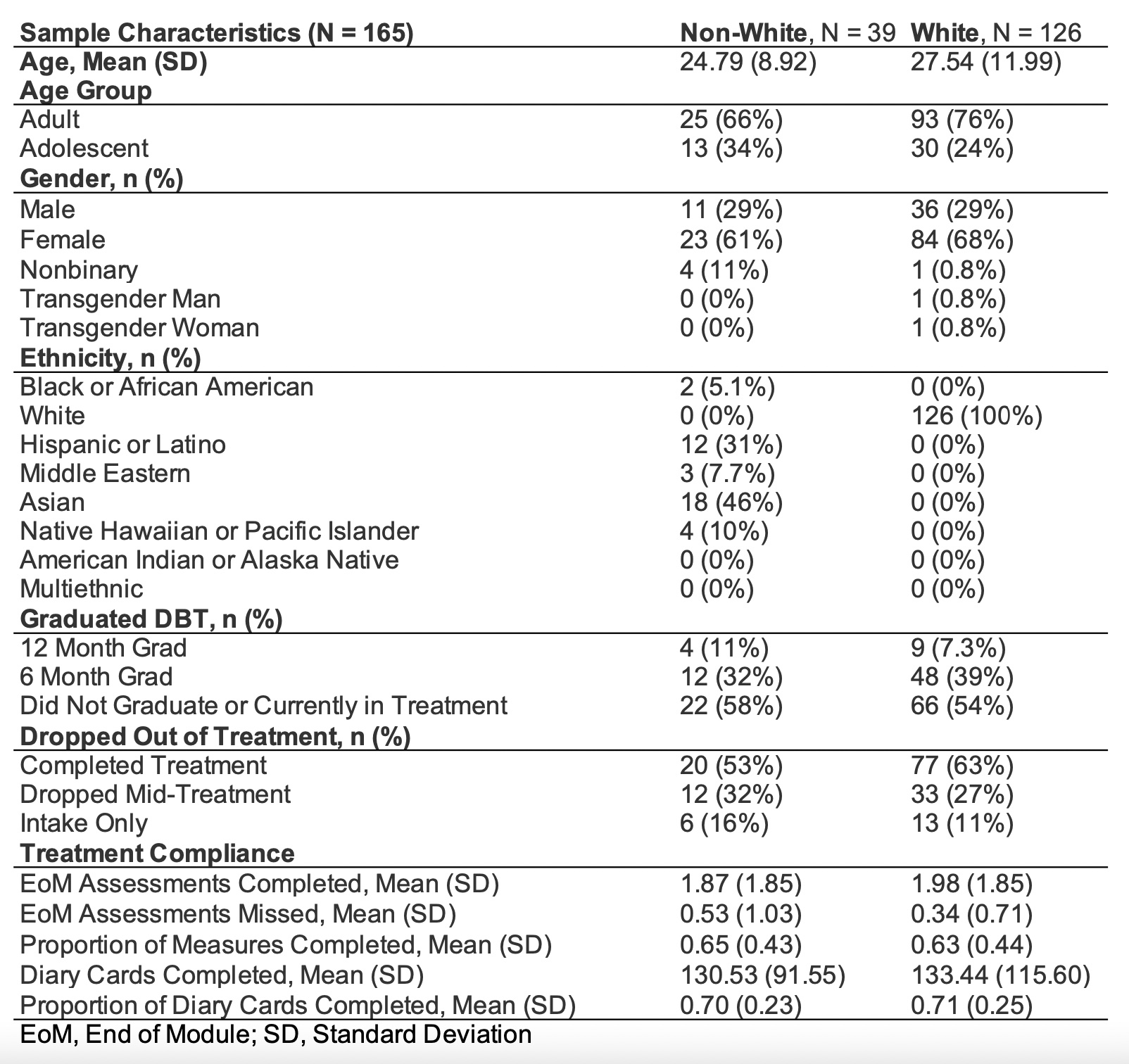
• Patients completing comprehensive DBT treatment at an outpatient clinic and training center in California (N = 165, 66% female)
• 39 (24%) identified their race or ethnicity as non-White: Black or African American, Hispanic or Latino, Middle Eastern, Asian, Native Hawaiian or Pacific Islander, American Indian or Alaska Native
Treatment Outcomes
Patients completed outcome measures at intake and every two months throughout DBT treatment:
• Functional Impairment (WSAS)
• Psychosocial Wellbeing (MHC-SF)
• Borderline Symptomology (BSL-23)
Treatment Compliance
• Phone coaching utilization
• Proportion of end of module assessments completed
• Proportion of diary cards completed
• Proportion of skills groups attended
• Graduation rates
• Dropout rates

Results
Treatment Compliance
There were no major differences between White and non-White patients:
• Average phone coaching calls per treatment module (1.7 vs. 1.9)
• Proportion of end of module assessments completed (63% vs. 65%)
• Proportion of diary cards completed (71% vs. 70%)
• Proportion of skills groups attended (79% vs. 77%)
• Dropout rates (27% vs. 32%)
• Graduation rates (46% vs. 42%)
Treatment Outcomes
• All patients on average experienced significant improvement over the course of treatment on all outcomes (ps < .001).
• There were no significant differences in the rate of improvement for White and non-White patients (ps < .05).
Discusion
Strengths
• Among the first studies to specifically explore differences in DBT treatment outcomes by ethno-racial identity
• A real-world descriptive study in an outpatient private practice
Limitations
• Categorization may be inaccurate since it was based on patients’ responses on a demographic form and not their self-identification as White or non-White.
• May not generalize as nearly all patients could afford to pay out-of-pocket
Conclusions
• Findings suggest that outpatient DBT may be an equally effective psychotherapy model for White and non-White individuals.
Research conducted by: Breanna Smith, M.A., Helene Diamond, M.S.W., Nadra Gabriel, M.A., Cassandra Lloyd, M.A, Liora Rabizadeh, B.A., Saad Iqbal, B.A., Tonia De Barros Barreto Morton, B.A., Robert Montgomery, M.A., and Lynn McFarr, PhD.
References
1. Panos, P. T., Jackson, J. W., Hasan, O., & Panos, A. (2014). Meta-Analysis and Systematic Review Assessing the Efficacy of Dialectical Behavior Therapy (DBT). Research on social work practice, 24(2), 213–223. https://doi.org/10.1177/1049731513503047
2. Harned, M. S., Coyle, T. N., & Garcia, N. M. (2022). The inclusion of ethnoracial, sexual, and gender minority groups in randomized controlled trials of dialectical behavior therapy: A systematic review of the literature. Clinical Psychology: Science and Practice


